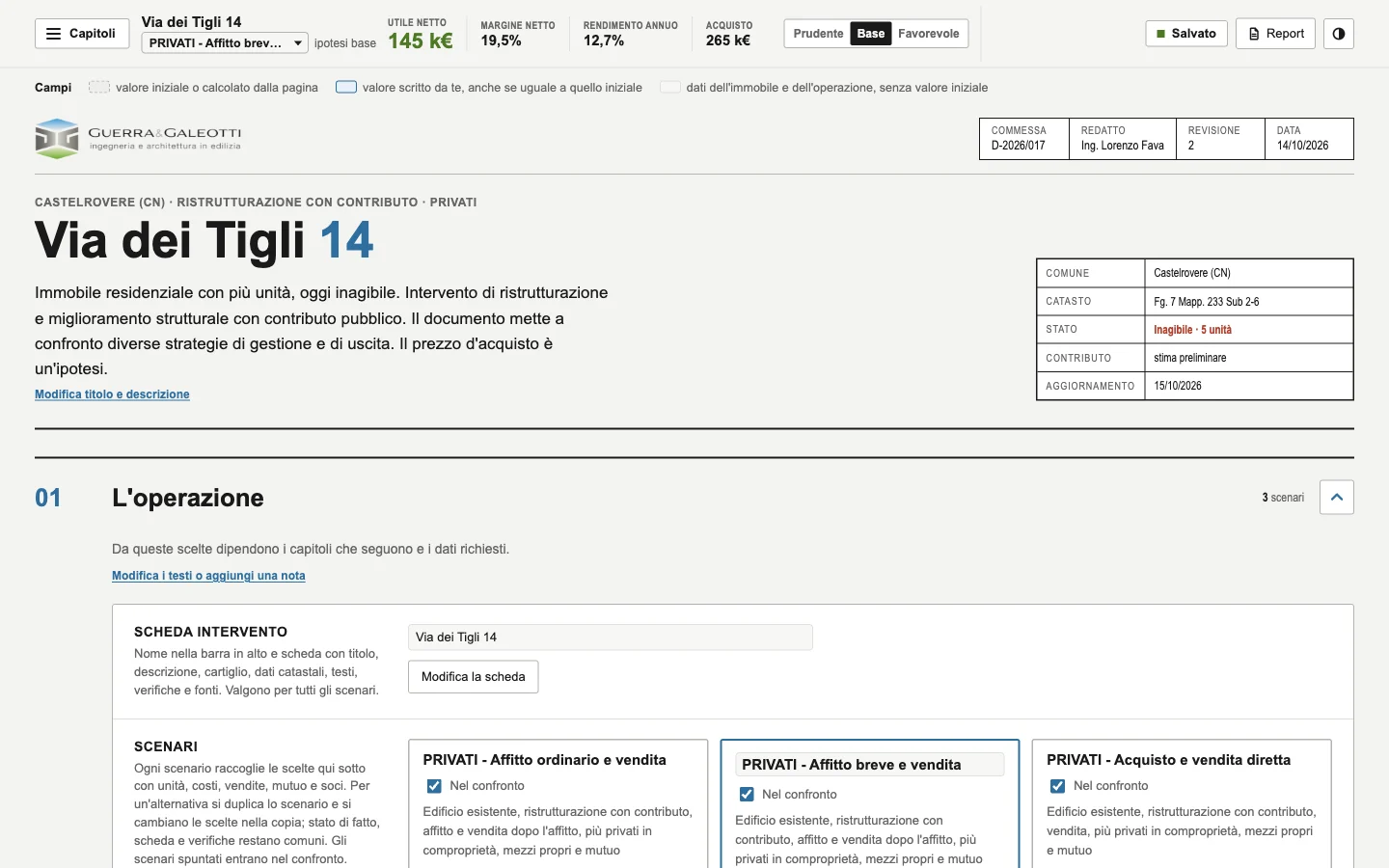
A real estate deal examined from every angle before deciding.
Holding and exit scenarios side by side, under three assumptions, with mortgage, partners and a final report. The case shown is fictitious, “Via dei Tigli 14”, with made-up figures.
The problem
Before buying a property to refurbish, let or sell on, there is one question: does it pay?
The answer depends on many variables that affect each other (price, taxes, construction cost, timing, mortgage, rents, sale prices) and it changes with every strategy and every assumption. Redoing the sums for each combination was slow, and the result was hard to explain to whoever had to decide.
The solution
A single interactive document, divided into chapters that follow the deal: change one figure and everything is recalculated.
It compares several holding and exit strategies under three assumptions, cautious, base and favourable, and works out profit, return, equity, mortgage and cash flows for each partner. At the end it produces the report to hand to investors and clients.
The main features
-
3.1
The property record and the scenarios
The deal opens with the property record and the scenarios to be compared.
- Chapters that follow the deal, from purchase to final payment
- Each scenario is a strategy: outright sale, standard letting, short-term letting
- At the top, always in view, the indicators of the chosen scenario
-
3.2
The price and the three assumptions
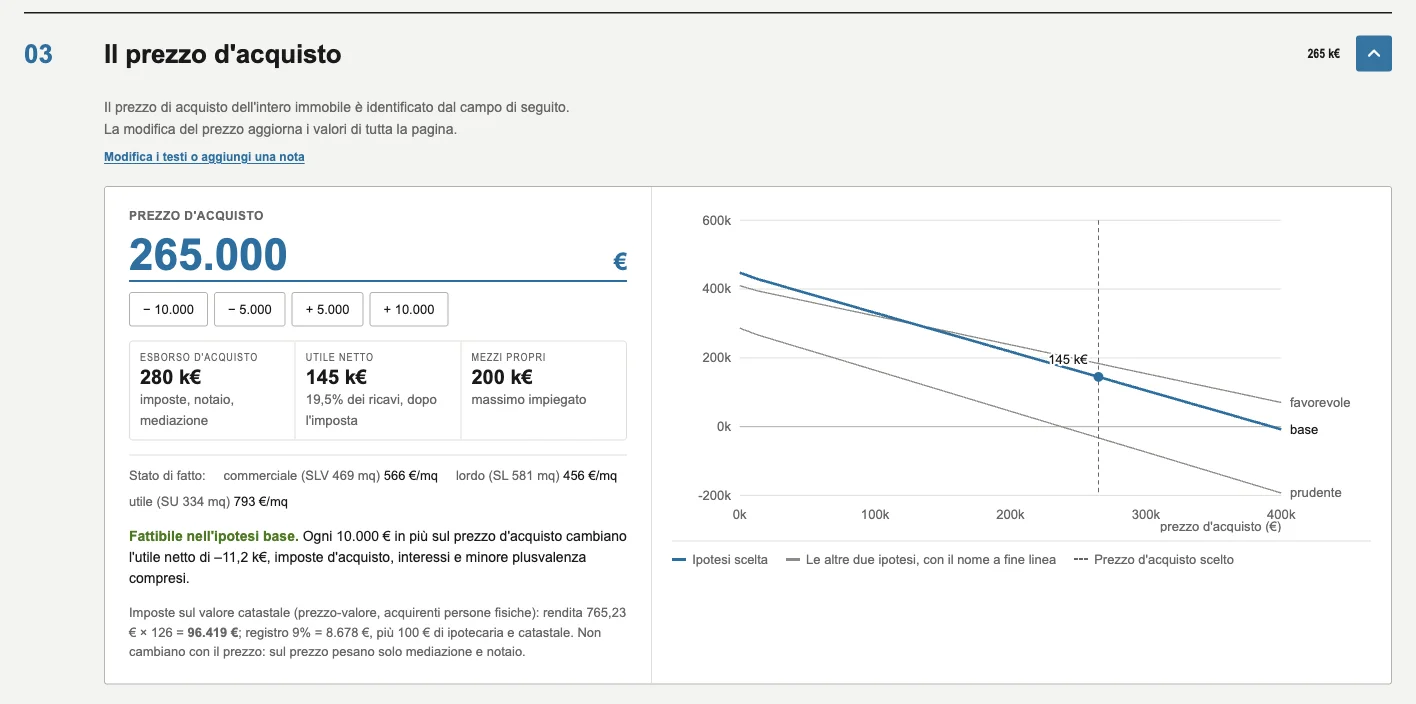
Every input has a cautious, base and favourable value; change one and the whole page is recalculated.
- The chart shows profit as the purchase price varies, under the three assumptions
- It shows at once whether the deal is viable and how much each €10,000 weighs
- Purchase taxes and costs calculated from the land registry data
-
3.3
Timing
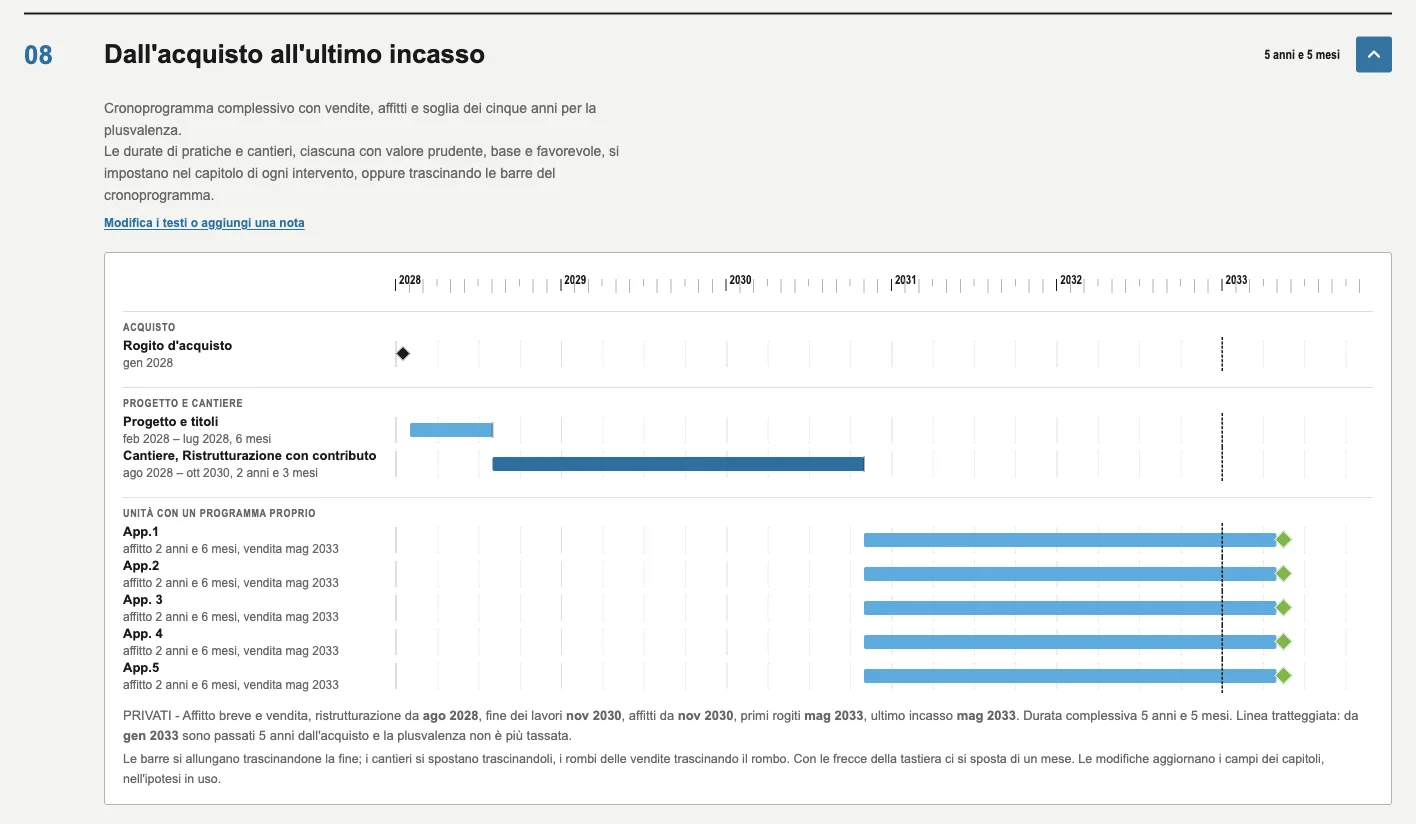
From completion to the final payment, month by month: timing affects interest, rents and taxes.
- Schedule with permits, works, lettings and sales
- The bars can be dragged and update the chapters
- The five-year threshold for capital gains is marked
-
3.4
Mortgage and cash
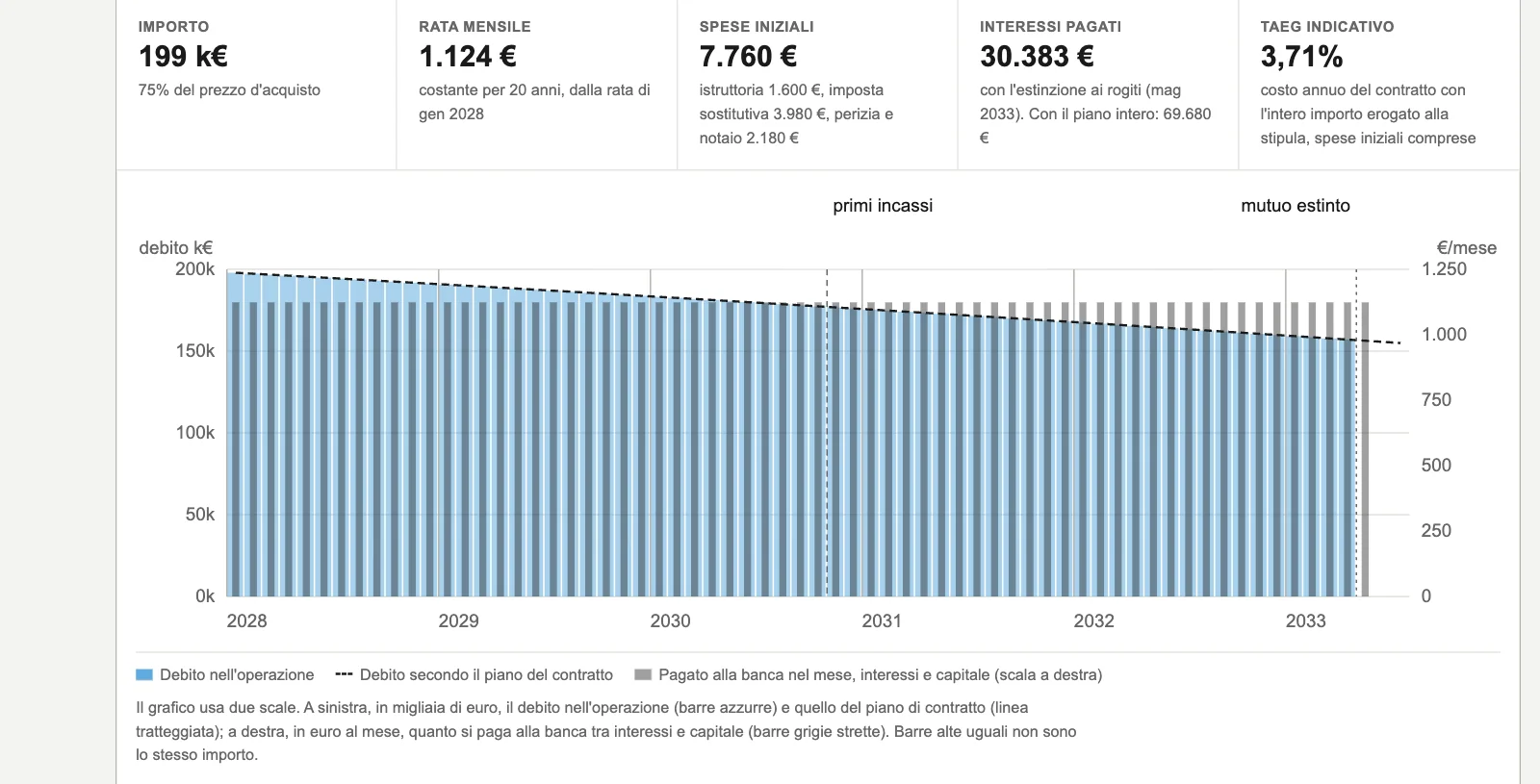
How much is owed to the bank and how much the partners have to put in, year by year.
- Mortgage plan with instalment, interest and APR
- Cash over time: the deal’s cash flow and peak exposure
- Table of income, outgoings and balance, with monthly detail
The mortgage 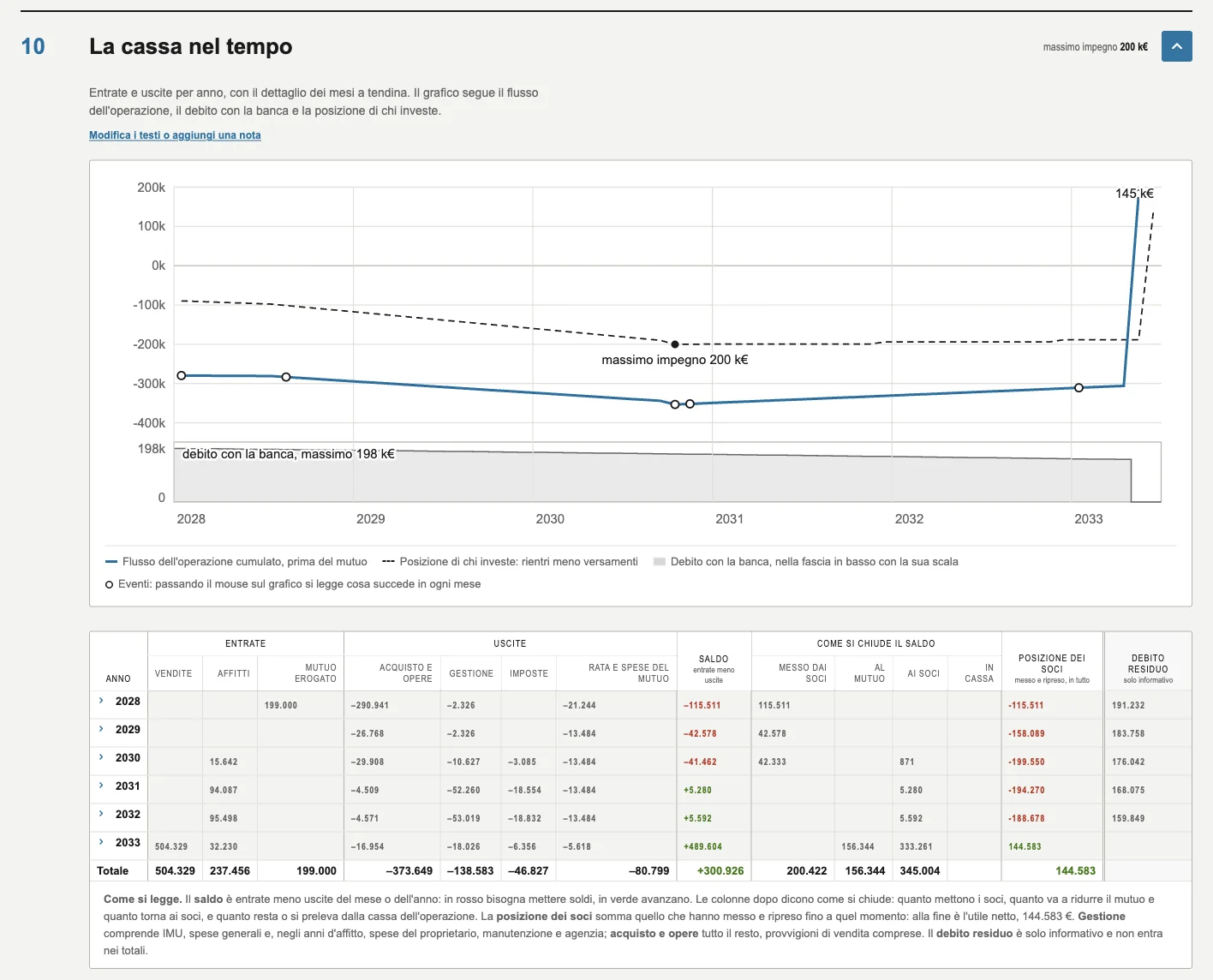
Cash over time -
3.5
The partners
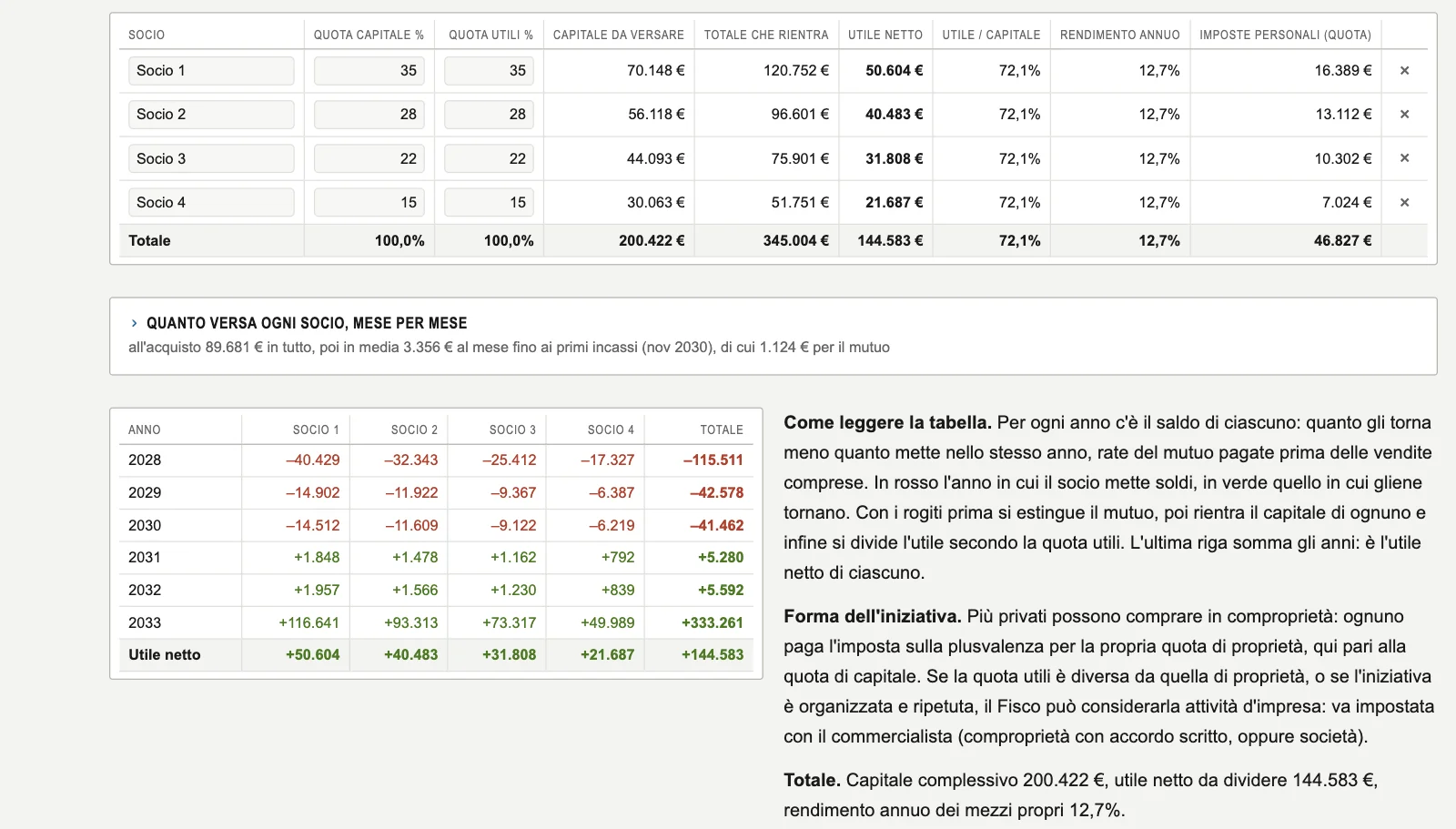
A deal shared by several people: who puts in what and what they get back.
- Shares of capital and profit
- Capital to contribute and taxes for each partner
- Year-by-year cash flows for each partner
-
3.6
The comparison and the report
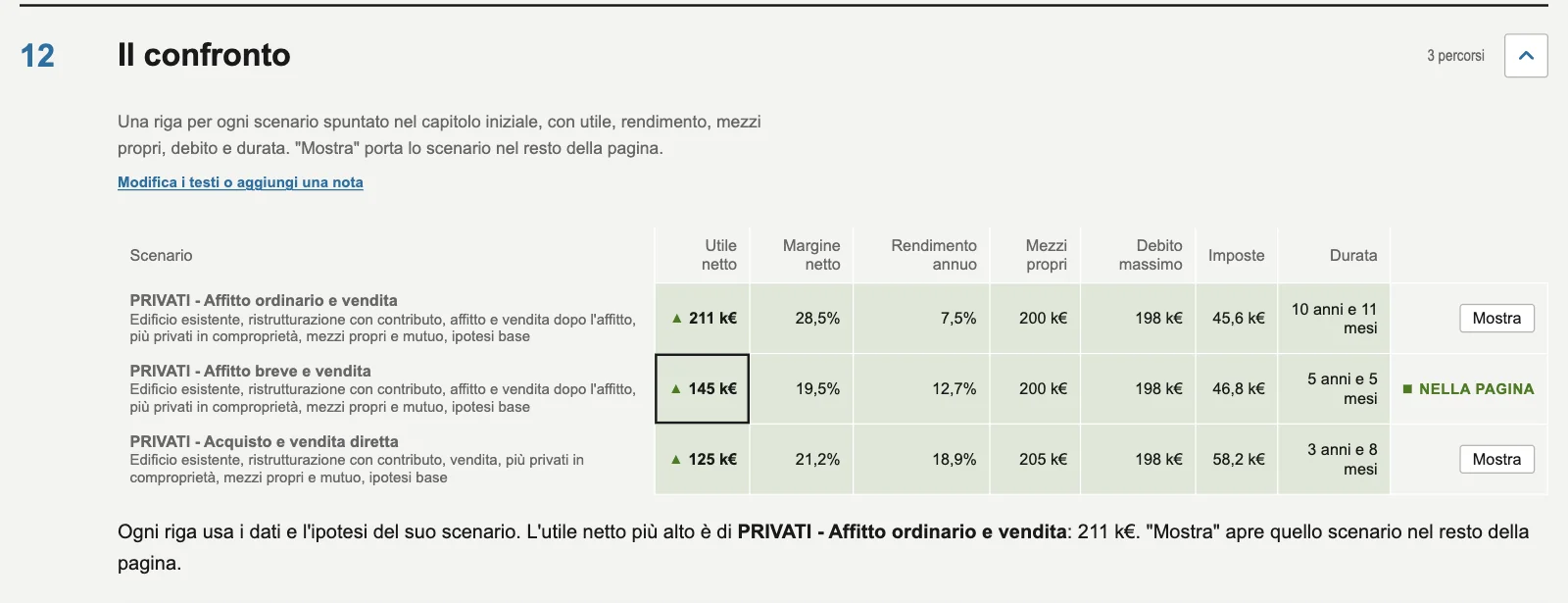
The scenarios side by side, and a document to hand to whoever has to decide.
- One row per strategy: profit, margin, return, equity, duration
- The report for investors and clients, with introduction, scenarios and risk analysis
- Break-even point and limit values for each item
The comparison 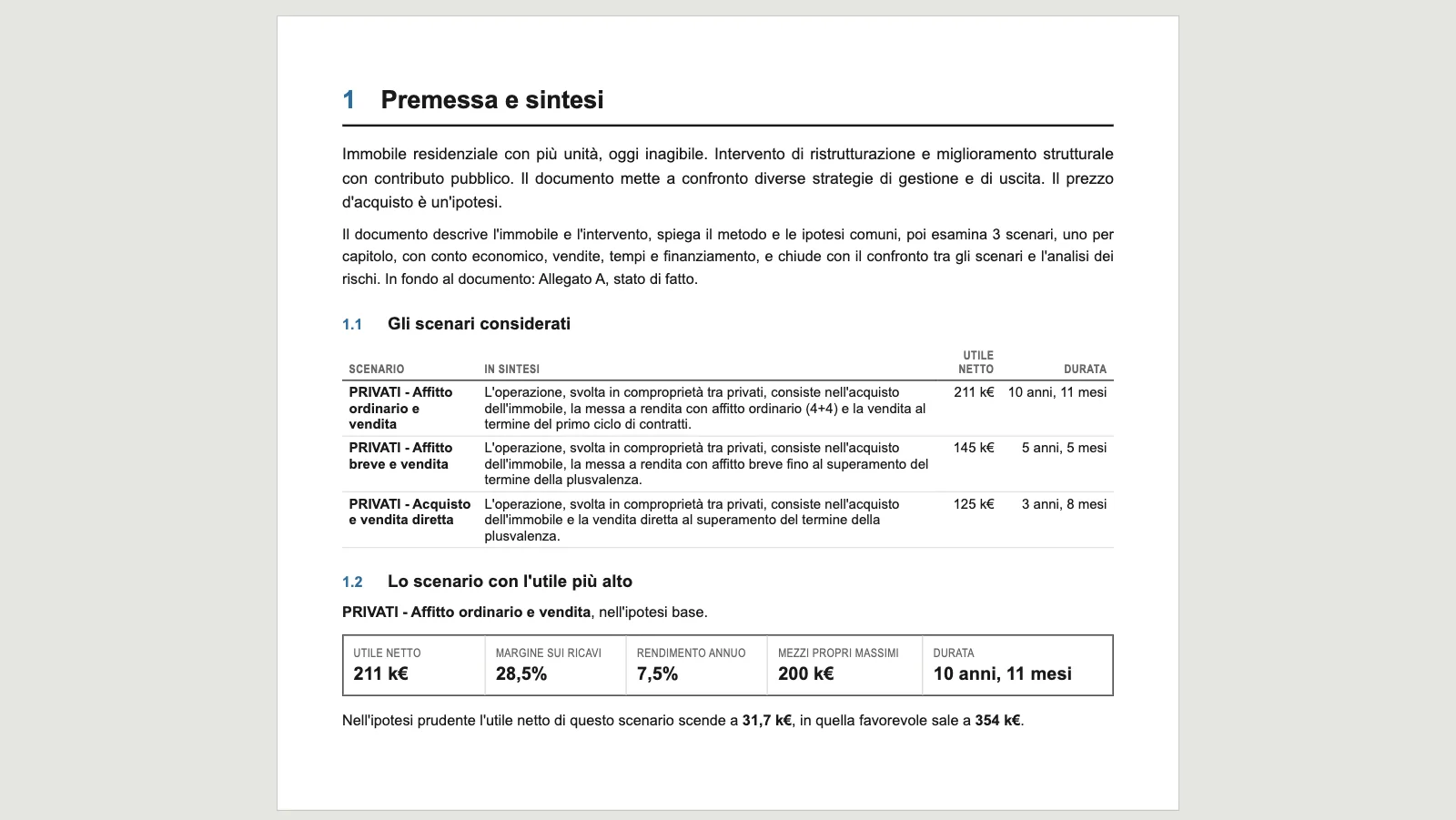
The report
Review and refinement
A decision tool is only as good as the trust in its numbers: every refinement went in that direction.
The chapters were rewritten until every number could be traced back to its source and every assumption could be read by someone who had not built the model.
- Every field shows where it comes from. Colour distinguishes an initial or calculated value from one entered by hand, and “Initial values” resets everything to the starting point.
- Three assumptions for every input. Cautious, base and favourable are not three separate files: you choose at the top and it applies to the whole page.
- Timing is adjusted by hand. The schedule can be dragged, and the durations flow back into the chapters that use them.
- Open checks stay visible. Whatever still needs confirming with the accountant, the bank or the authorities is listed at the end, and the report carries it.
The result
- Chapters
- 13
- Assumptions
- 3
- Scenarios
- side by side
- Output
- report
A deal is assessed in one place, from the first assumption to the final document. The report brings together introduction, method, scenarios, comparison, risk analysis and break-even point, with the assumptions stated: it is ready to hand to investors and clients.
How I built it
- The rules are mine. I defined the workflow, the checks and the edge cases myself, based on how we really work.
- Claude writes the code. One feature at a time, with Claude Code, describing the problem and reviewing the solution.
- Checking stays with me. Every feature is tested on real cases before it goes into everyday use.
The screenshots use sample data only: the data of the practice, its clients and its real transactions remain confidential.
Analysis tool
The case shown is fictitious,
with made-up figures
Analysis and report
Real estate investment appraisal.
A deal examined from every angle before deciding
Designed by
Lorenzo Fava
Built with
Claude Code
Case shown
Via dei Tigli 14, fictitious
Year
2026
Document
Investment appraisal
Scenarios, three assumptions, mortgage, partners, report